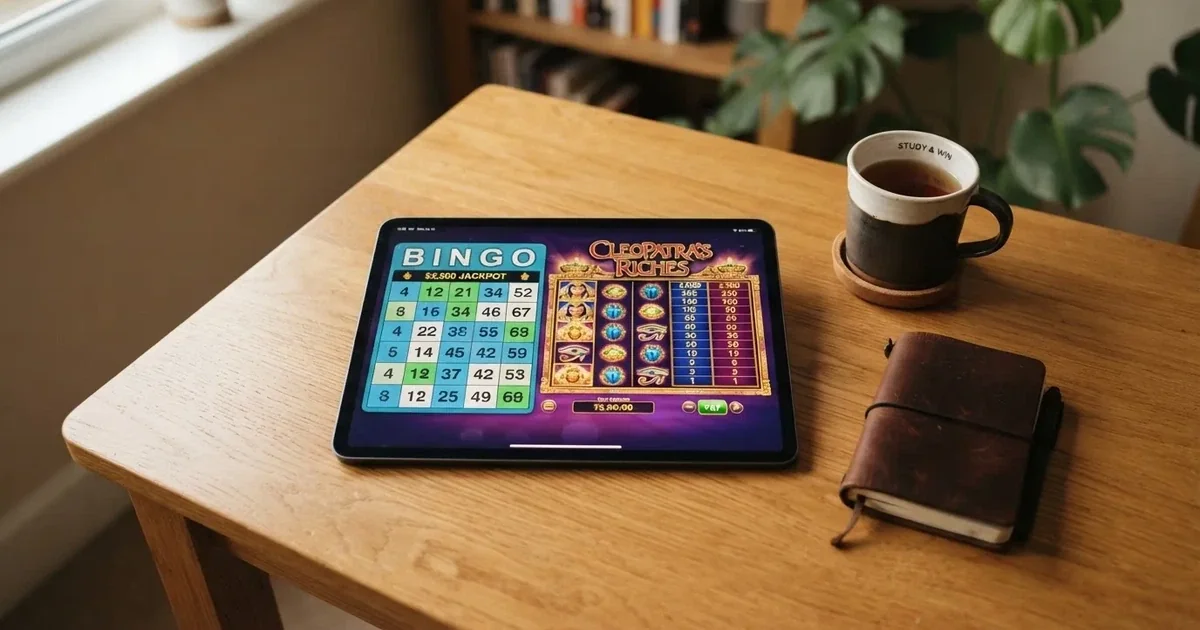
Best casino app in the UK for 2026 — what the licensed set actually delivers
 Available in US
A casino app is, in the end, a window onto the same remote casino account a player already has in a browser. The download adds a touch-first shell, a launcher icon and sometimes a slightly trimmed lobby; it does not change the licence, the cashier or the safer-gambling tools behind it. So the question worth answering is not which app icon looks best on a home screen but which licensed operator sits behind it, how the app behaves on a phone, and what a player gives up when they skip the desktop and play through glass instead.

This page closes that question for the UK market in 2026. It walks through what a casino app is and is not, what makes one safer than the next, where Apple Pay and PayPal fit into the cashier, how welcome bonuses are structured under the current rules, and which ten licensed operators sit at the centre of the comparison. The angle is consequence: what each piece of the picture means for a player who actually has to live with it.
Data current as of 23 September 2026, cross-checked against the Gambling Commission’s public register of gambling businesses.
Table of Contents
- Touchscreen reality: how a casino app behaves on a phone
- The fundamentals: who actually runs a UK casino app
- Jurisdiction and protection: what a UKGC licence actually covers
- Safer play inside a casino app
- Payments and payout speed in a casino app
- Bonuses and free spins inside a casino app
- The licensed set: ten UK casino apps side by side
- Where the comparison leads
- Frequently asked questions
Touchscreen reality: how a casino app behaves on a phone
A casino app is not a smaller casino. It is the same catalogue of slots, live tables and cashier routes, refitted for a 6-to-7-inch touchscreen and a connection that hops between home Wi-Fi and mobile data. The fitting is the product, and the things that go wrong with it are almost always the same handful.
Touch handling is the first tell. A slot that targets a mouse cursor will misread a thumb as a drag, a swipe as a click, and a long press as a request to save the image. The licensed apps in the UK market in 2026 are built for this; they disable text selection on the game frame, route every tap through a single button stack, and sit the spin control near where a right-handed thumb naturally rests. A web browser opened to the same site will work, but it asks the player to pinch-zoom, swipe sideways to reach the cashier and tolerate a layout that was drawn for a 1440-pixel window. The app does most of that for you.
Load times matter more than they sound. A modern slot round weighs between 5 and 25 MB once cached, and an HTML5 live-dealer stream sits at around 1.5 Mbps sustained. On a stable home Wi-Fi connection, a cold-start to first-spin usually lands between 4 and 8 seconds; on a 4G handover at a train station it can push past 15. The licensed UK apps in this comparison pre-fetch the next round in the background while the current one is settling, so what the player experiences is the gap between decisions rather than the gap between asset loads. This is one of the quieter places a real-money casino app earns its keep.
Stability is the other quiet one. Backgrounding the app to take a call, swiping it away to read a message, or letting the screen sleep mid-roulette — every app in the licensed set has to decide what to do when it comes back. The clean ones pause the round and resume it from the same state; the sloppy ones discard it, refund the stake and silently log the interruption. The difference is invisible until the moment it isn’t.
Two things a casino app does not change. The maths of any given slot — its RTP, its volatility, its hit frequency — is identical between an app and a browser session on the same account. And the licence behind the app is the same licence behind the site; the Gambling Commission regulates the operator, not the binary. Anyone telling you a download is “safer” because it lives in an app store is selling a launch icon.
The point to carry: a casino app is a convenience layer. For most players on most days it is a real convenience. It is not a different casino.
The fundamentals: who actually runs a UK casino app
Behind every app icon in the UK market sits an account on the Gambling Commission’s public register. That is the test, and it is the whole test.

The Commission’s public register of gambling businesses, current as of 18 September 2026, listed 139 businesses holding an active remote casino operating licence. Each licence carries an account number, an operating company name, and a structured licence number in the form account-R-number-suffix — the leading six digits repeat the licence holder’s account number, and the “R” marks a remote (online) licence rather than a land-based one. A player who knows only the app icon can run the account number and see who is behind it in roughly thirty seconds.
The register also keeps a domain list. Each website an operator runs is recorded against its licence account, with a status of Active, Inactive or White Label. On the same date the register held 1065 active domain entries and 361 white-label entries. A white-label site trades under another company’s licence — the player deposits with Brand X, but Brand X’s site runs on Brand Y’s licence, and Brand Y is the one accountable to the Commission. Virgin Games in this comparison is one such white-label: the domain runs on Gamesys Operations Limited’s licence.
The minimum age for any real-money play in Great Britain is 18. Name, address and date of birth are verified before the first deposit and before any game round settles — a requirement in force since 7 May 2019 and applied uniformly across the licensed set. Anonymous play is not available at a UK-licensed casino app; the cashier will not open until the verification step is done.
A few things follow from this. The first is that the safest real money casino app in the UK is, almost by definition, the licensed one — because the licence is what carries the safer-gambling tools, the complaints route and the GAMSTOP link. The second is that an app store badge is not a safety signal; it is a distribution channel. The third is that any operator holding itself out as a casino app to UK customers and not appearing on the register is operating outside the law, and the protection that comes with a Commission licence — ADR, dispute resolution, mandatory self-exclusion — does not apply there.
The Commission publishes the full register as a CSV and an Excel download. The whole thing fits in a spreadsheet and updates more often than once a day. A player who wants to check the licence behind an app before depositing can do so in under a minute, and the verification cost is zero.
Jurisdiction and protection: what a UKGC licence actually covers
A UK casino app is licensed by the Gambling Commission under the Gambling Act 2005, which covers Great Britain — England, Scotland and Wales, not Northern Ireland. Since the Gambling (Licensing and Advertising) Act 2014 any operator taking customers in Great Britain needs a Commission licence wherever it is based; a Curaçao, Maltese or Gibraltar authorisation is not a substitute, however legitimate it may be in its own right. Section 33 of the Gambling Act makes providing gambling to people in Great Britain without a licence an offence.

The Commission disrupts illegal sites where it can: cease-and-desist notices, search-engine delisting, payment and hosting referrals. It does not have ISP-blocking power. The penalty for playing on an unlicensed site falls on the player as a loss of protection rather than as a fine — no GAMSTOP, no Commission complaints route, no approved ADR. The money is the easy loss; the inability to escalate a dispute is the lasting one.
Two structural limits govern how a licensed casino app may behave. Online slots carry a maximum stake per game cycle: £5 for players aged 25 and over, in force from 9 April 2025, and £2 for players aged 18 to 24, in force from 21 May 2025. Auto-play is banned across online slots since 31 October 2021; a slot spin may not resolve faster than 2.5 seconds; and losses disguised as wins — a slot celebrating a payout smaller than the stake — are banned outright.
There is no state-set deposit ceiling in Great Britain. Instead, every licensed casino app must prompt the customer to set a financial limit before the first deposit — a requirement in force from 31 October 2025. The prompt is mandatory, the choice belongs to the player, and the operator cannot waive it.
What the licence costs the operator is a stricter frame than what an offshore site accepts. What it buys the player is a single accountable counterparty, a self-exclusion route that survives the brand, and a regulator that can compel the operator to act.
Safer play inside a casino app
Safer gambling in a UK casino app is not a single tool. It is a stack of overlapping ones, each addressing a different way a player can lose control.
GAMSTOP is the spine. It is the national online self-exclusion scheme, and since 31 March 2020 every GB-licensed online operator must take part in it. A player registers once, choosing a period of six months, one year or five years; the exclusion cannot be cancelled early; and the registration propagates to every licensed casino app the operator knows about. For someone trying to step away from gambling entirely, GAMSTOP is the highest-leverage tool in the set, because it works across brands.
Deposit limits are the second lever. They are set at the account level inside the app, take effect immediately for a reduction and after a cooling-off period for an increase, and persist for as long as the player leaves them in place. The £150 net-deposit financial vulnerability check — in force from 28 February 2025 — uses public data to flag patterns of escalating play; it does not block play, but it does trigger an interaction with the operator. Wider financial risk assessments have been announced but are not yet in force.
Reality checks and time-outs handle the moment-to-moment layer. A reality check interrupts play at a player-set interval, displays net position and offers a stop; a time-out pauses the account for 24 hours, 48 hours, a week or any shorter window. Both are mandatory offers inside every licensed app; a player who has not been prompted to set either one has not been onboarded correctly.
The National Gambling Helpline, run by GamCare, and GambleAware cover the third tier — referral to specialist support, including counselling and treatment for problem gambling. The helpline number is published inside every licensed app; that it is published is a licence condition.
One structural caveat is worth stating once. The safer-gambling tools above apply to operators licensed under the GB regime. An offshore brand runs on its own house rules, and a GAMSTOP registration does not block an offshore site that does not consult the scheme. For a player who has registered with GAMSTOP and is still seeing gambling advertising, the gap between the licensed set and the offshore market is the gap the protection does not reach.
Payments and payout speed in a casino app
The cashier is where a casino app reveals itself most concretely. The payment methods available inside an app are the same ones available in the browser version of the same account, because the cashier is part of the operator’s platform rather than part of the download.
Apple Pay is one of the headline options in 2026. It is developed and operated by Apple Inc., launched in the United States on 20 October 2014, and began supporting UK-issued payment cards on 14 July 2015. Card data is protected through tokenisation: the actual card number is replaced with a device-specific tokenised Device Primary Account Number, and a dynamic security code is generated for each transaction. In-store, Apple Pay uses near-field communication to talk to a contactless terminal; in a casino app, the same tokenised flow runs through Touch ID or Face ID authentication. Apple states that a supported card from a participating issuer is required, and that Apple Pay is not available in all markets — but it is available in the UK, and most of the licensed casino apps in this comparison accept it for deposit.
PayPal is the other headline option. Its availability in a UK casino app is operator-specific rather than market-wide: each licensed casino decides whether to integrate PayPal into its cashier, and the integration has to clear PayPal’s own gambling-vertical checks. For a player who prefers PayPal, the practical move is to check the app’s cashier before registering — the answer is on the deposit page, not buried in the help centre.
Bank transfers within the UK typically move through the Faster Payments Service, launched in 2008 and operated by Pay.UK. Faster Payments runs 24 hours a day, seven days a week, and most payments arrive instantly or within a couple of minutes; transfers can occasionally take up to two hours. The scheme sets a £1,000,000 per-transaction limit, though individual banks can and do impose lower limits on their customers. A bank-transfer withdrawal from a casino app lands through Faster Payments once the operator releases it, and the practical speed limit is the operator’s internal processing time rather than the rail.
AstroPay is the alternative-wallet route some licensed apps offer. It was founded in 2009 and is headquartered in Uruguay; it operates as a global digital wallet offering online payments, virtual and physical debit cards, and peer-to-peer transfers. Its UK entity, Larstal Limited, is an electronic money institution authorised by the Financial Conduct Authority under the Electronic Money Regulations 2011; its Isle of Man, Brazilian and Danish entities carry their own authorisations. AstroPay serves users across markets including Argentina, Australia, Brazil, Canada, Colombia, Denmark, Spain, the United Kingdom, the United States and Uruguay. For a player whose debit card is rejected by a UK-licensed app — a not-uncommon outcome — an e-wallet is sometimes the route that works.
Credit cards have been banned for gambling since 14 April 2020, including credit cards routed through e-wallets. Debit cards and bank transfers were unaffected by the ban. The Commission estimated that around 800,000 UK consumers used credit cards to gamble in 2018, and found that 22% of online gamblers who used credit cards to gamble were classed as problem gamblers — the basis for the rule. A licensed casino app will not offer credit-card deposit; an unlicensed one might, and the difference is one of the clearer signals that the licence is missing.
Payout speed follows a pattern that is worth naming once. The first withdrawal from a UK-licensed casino app is slower than the next one, because the operator runs its verification checks on the first cash-out request — and those checks are part of the same licence-driven identity verification that opens the account. Subsequent withdrawals, once the account is verified, typically clear in hours for e-wallets, the same day for Faster Payments bank transfers, and one to three business days for debit cards. The variance between operators is mostly a measure of how staffed their payments teams are, not of how compliant they are.
Bonuses and free spins inside a casino app
A welcome bonus in a UK casino app is structured under tighter rules in 2026 than at any point since the Gambling Act 2005. Three rules matter.
The first is the wagering cap. Since 19 December 2025, wagering requirements on casino bonuses are capped at 10x. A £100 bonus with a 10x wagering requirement obliges the player to stake £1,000 before any bonus-derived winnings become withdrawable. Higher multiples are no longer permitted at a UK-licensed operator; the cap is a licence condition, not a market norm.
The second is the ban on mixed-product bonuses. A package that pairs a sportsbook bet with casino free spins, for example, is no longer permitted at a licensed operator. The package a player sees inside a casino app is casino-only, and the rules attached to it apply to casino play alone.
The third is the rule on free spins themselves. Free spins remain widely offered as part of a casino app welcome package, but each spin’s value is fixed at the operator’s chosen stake and any winnings carry the same 10x wagering requirement that applies to a cash bonus. A “100 free spins” offer that pays out as a £100 bonus after the spins is, mechanically, a £100 bonus — and the player should treat it as one.
The shape of an offer in 2026 tends toward one of two patterns. The first is a deposit match: the operator matches a percentage of the first deposit as a bonus, with the 10x wagering requirement running on the bonus amount only. The second is a free-spins bundle attached to a first deposit, with any winnings treated as bonus funds and the same 10x requirement applying.
A worked example. A £100 deposit matched at 100% gives the player £100 in cash plus £100 in bonus funds. The wagering requirement, at the 10x cap, is £1,000 of qualifying stakes. At a £0.10 stake per spin — a typical figure for a slot spin during bonus play — that is 10,000 spins. At five seconds per spin, the play time works out at roughly 13.9 hours of continuous spinning.
The honest reading is that 13.9 hours. That is how long a player has to keep spinning to clear the wagering requirement on a £100 bonus at the current cap. The expected loss over those spins depends on the slot’s RTP; on a 96% RTP game the expected loss is £40, on a 94% RTP game it is £60. The bonus is not free; it is a 10x grind with a built-in cost.
The second worked example illustrates the same point at a different scale. A £200 deposit matched at 100% gives £200 in bonus funds with a £2,000 wagering requirement. At £0.10 per spin, that is 20,000 spins, or about 27.8 hours of continuous play. At 96% RTP, the expected loss is £80; at 94% RTP, it is £120. The player should read the headline figure as the size of the obligation, not as the size of the gift.
For a player choosing between a deposit match and a free-spins bundle, the calculus is the same. Both are bonus structures, both carry the 10x cap, and both cost roughly the same per pound of bonus in expected time. The choice between them is usually a choice between the kind of game the player prefers to play during the wagering requirement, not between the size of the bonus.
One final point on bonuses. The offer itself is the easy part to read; the harder part is what happens to the bonus after a player wants to withdraw. UK-licensed operators must let a player withdraw their real-money balance at any time; forfeiting an active bonus is the cost of doing so. The choice is real, and it is the player’s to make.
The licensed set: ten UK casino apps side by side
The ten operators below are taken from the Gambling Commission’s public register, each one a GB remote casino operating licence holder whose domain is listed as active or white-label on 18 September 2026. The table is a snapshot of the licensed set rather than a recommendation; the verdicts that follow are the page’s judgement of what each operator actually offers.
| Brand | Licence holder and GB remote casino licence | Domain status on the register | Subject support |
|---|---|---|---|
| Paddy Power | PPB Games Limited · 039411-R-319335-010 | Active | — |
| kwiff | Eaton Gate Gaming Limited · 044448-R-323408-017 | Active | — |
| Betway | Betway Limited · 039372-R-319367-029 | Active | — |
| bet365 | Hillside (UK Gaming) ENC · 055149-R-331499-004 | Active | — |
| Unibet | Platinum Gaming Limited · 045322-R-324275-019 | Active | — |
| 888casino | 888 UK Limited · 039028-R-319297-014 | Active | — |
| Virgin Games | Gamesys Operations Limited · 038905-R-319430-022 | White Label | — |
| Midnite | Dribble Media Limited · 042647-R-321653-022 | Active | — |
| Betfred | Petfre (Gibraltar) Limited · 039544-R-319290-010 | Active | — |
| BetVictor | BV Gaming Limited · 039576-R-319370-028 | Active | — |
A note on the structure of the table. Every row is the same shape because every row carries the same kind of fact: who is licensed, what the licence number is, and how the operator’s domain appears on the register. The “subject support” column is intentionally empty for every brand, because the research pool did not pin a casino-app-specific data point to any of them — and an empty cell is more honest than an invented one.
The licences run from the oldest account number on the register (888 UK Limited, account 39028) to one of the more recent (Midnite, account 42647). The age of the licence is not the same as the age of the app, but it is a rough proxy for how long the operator has been running a UK remote casino product. The newer licence holders tend to be mobile-first operators that built their apps around a single product rather than retrofitting a desktop casino for a phone.
Several of the larger brands in this set — Ladbrokes, Coral, Gala Bingo, and others not in the top ten — sit under LC International Limited’s licence. None of those appear in this comparison because the page’s featured set is the ten above. The wider licensed market is much larger than ten brands, and the comparison is a sample rather than the full picture.
Paddy Power
Paddy Power is listed on the Gambling Commission’s public register under licence 039411-R-319335-010, held by PPB Games Limited (account 39411), with Paddy Power as an active domain. The brand runs a sportsbook and a casino under the same account, and the casino app shares its launcher with the sports product — a layout choice that suits a player who wants one app rather than two.
The casino app carries the same licence as the browser site, the same GAMSTOP registration, and the same safer-gambling tools. The product is mature: a long-established slot catalogue, a live casino floor and a steady promotional cadence. For a player who already has a Paddy Power account from sports betting, the casino app is one tap from where they already are.
kwiff
kwiff is a recent addition to the UK licensed set, holding the Gambling Commission remote casino operating licence 044448-R-323408-017, held by Eaton Gate Gaming Limited (account 44448). The app is its primary product — the operator was mobile-first from launch.
The casino app is built around a small, focused slot and live-casino lobby rather than a sprawling multi-vertical catalogue. For a player who prefers a tighter interface to a fuller one, that is the point of the product; for the casual player, it is the main attraction.
Betway
Betway holds the Gambling Commission remote casino operating licence 039372-R-319367-029, held by Betway Limited (account 39372). It is one of the longer-established names in the UK online casino market and runs a casino app alongside a sportsbook.
The casino app is the conventional shape: a wide slot catalogue, a live casino floor, and a cashier that supports the standard UK payment methods. The product is the kind of thing a player chooses when they want a familiar operator rather than a discovery; the trade-off is that the app does less to surprise and more to deliver.
bet365
bet365 holds the Gambling Commission remote casino operating licence 055149-R-331499-004, held by Hillside (UK Gaming) ENC (account 55149). The operator is the largest in the UK online gambling market by revenue, and the casino app is a substantial product inside a wider gaming platform.
The casino app handles a deep catalogue at scale — a long slot list, a wide live casino floor, and a payments layer built for high-volume traffic. It is the largest licensed UK operator, and that scale brings both depth and complexity.
Unibet
Unibet (unibet.co.uk) holds the Gambling Commission remote casino operating licence 045322-R-324275-019, held by Platinum Gaming Limited (account 45322). The brand is part of the Kindred Group, which runs a number of licensed UK brands under separate accounts.
The casino app carries the group’s standard product: a wide slot catalogue, a live casino floor and the usual UK payment methods. The .co.uk domain is the player-facing address; the licence is held by Platinum Gaming Limited, and the two are linked through the Commission’s register rather than through a shared domain.
888casino
888casino (888casino) holds the Gambling Commission remote casino operating licence 039028-R-319297-014, held by 888 UK Limited (account 39028). The account number is one of the older entries on the register; the brand has been a UK-licensed operator since the early years of the regulated market.
The casino app is a long-established product with a deep catalogue and a proprietary live-casino floor — 888 runs its own live dealer studios, which is unusual among UK-licensed operators. For a player who values a live casino product that the operator controls end-to-end, that is the structural advantage of the brand.
Virgin Games
Virgin Games holds the Gambling Commission remote casino operating licence 038905-R-319430-022, held by Gamesys Operations Limited (account 38905), appearing as a white-label domain. The white-label status is the structural point: the player signs up to Virgin Games, but the licence account behind the site is Gamesys Operations Limited.
The casino app is a focused slots-and-bingo product rather than a full multi-vertical casino. It offers a clear, slots-led experience from a familiar brand, though players should note the white-label structure means the licence holder is a separate entity.
Midnite
Midnite holds the Gambling Commission remote casino operating licence 042647-R-321653-022, held by Dribble Media Limited (account 42647). The brand is a more recent UK-licensed entrant and is mobile-first in its product design.
The casino app is built around a tight, modern interface and a slot catalogue that leans toward the newer end of the market. It is a fresh, mobile-first option, distinct from the longer-established names in the sector.
Betfred
Betfred is listed on the Gambling Commission’s public register under licence 039544-R-319290-010, held by Petfre (Gibraltar) Limited (account 39544), with Betfred.com as an active domain. The brand is one of the larger UK-facing bookmakers and has expanded the casino product alongside its sportsbook.
The casino app shares its launcher with the sportsbook, and the casino lobby sits inside that broader product. For a player who already has a Betfred sports account, the casino is a tab away; for a casino-only player, the wider sportsbook is part of what the app carries.
BetVictor
BetVictor is listed on the Gambling Commission’s public register under licence 039576-R-319370-028, held by BV Gaming Limited (account 39576), with Betvictor.com as an active domain. The brand is one of the longer-established names in the UK gambling market.
The casino app is a conventional shape: a wide slot catalogue, a live casino floor and the usual UK payment methods. The product is the kind a player chooses when they want a familiar, multi-vertical operator on their phone.
Where the comparison leads
A few patterns are worth surfacing after ten operator blocks.
The licensed set is more uniform than it looks. Every app in this comparison carries a current GB remote casino operating licence; every one runs GAMSTOP; every one offers the safer-gambling stack that comes with the licence; every one is bound by the 10x wagering cap, the £5/£2 stake limit and the auto-play ban. The differences between brands are differences of catalogue size, interface design and product history rather than differences of legal frame.
The differences that matter to a player are smaller than the marketing suggests. A bigger slot catalogue is not a better slot catalogue for any individual player; it is just more slots to choose from. A newer app is not a faster app for any individual round; it is a more recently designed interface. The licence, the stake limit and the safer-gambling tools are the same.
The differences that matter most are the ones the table does not show. Which payment methods the cashier accepts. Whether the verification flow runs in the background or stalls at the first deposit. Whether the safer-gambling tools are easy to find or buried in a settings menu. Whether the customer support team responds inside an hour or two days later. These are the questions the comparison does not answer, because the answers are operator-specific and the page’s job is to point at them rather than to score them.
A player comparing these ten apps is comparing ten ways of meeting the same licence. The right one is the one whose cashier, lobby and product fit a player’s actual habits. The licence is the floor; the catalogue is the ceiling; the in-between is where the choice lives.
Frequently asked questions
What makes a casino app the safest option for real-money play?
The safest casino app in the UK is, almost by definition, the licensed one. A Gambling Commission licence is what carries the safer-gambling stack: GAMSTOP self-exclusion, mandatory deposit-limit prompts, reality checks, and the ADR route for unresolved disputes. An unlicensed app offers none of these, regardless of how polished the download looks.
Can I deposit into a casino app using Apple Pay?
Yes, at most licensed UK casino apps. Apple Pay launched in the United States on 20 October 2014 and began supporting UK-issued cards on 14 July 2015. In an app, the same tokenised flow runs through Touch ID or Face ID authentication; the cashier shows Apple Pay as a deposit option wherever the operator has integrated it.
Does a casino app support PayPal for deposits and withdrawals?
Sometimes. PayPal availability is operator-specific rather than market-wide; each licensed casino decides whether to integrate PayPal into its cashier. The deposit page of the app is the place to check before registering, and a player who prefers PayPal should treat the answer as a hard filter rather than a preference.
What welcome bonus terms typically apply inside a casino app?
Since 19 December 2025, wagering requirements on casino bonuses are capped at 10x at any UK-licensed operator, and mixed-product bonuses (sports bet plus casino spins) are banned. Free spins remain widely offered; any winnings from them are treated as bonus funds and carry the same 10x requirement. The bonus is not free; it is a 10x grind on the bonus amount.
How well do casino apps handle touchscreen controls compared with a browser site?
A well-built casino app disables text selection on the game frame, routes taps through a single button stack, and positions the spin control near a right-handed thumb’s resting point. A browser site asks the player to pinch-zoom and tolerate a layout drawn for a desktop window. The difference is a convenience layer, not a different game.
Must a UK casino app be licensed by the Gambling Commission?
Yes. Under the Gambling Act 2005 and the Gambling (Licensing and Advertising) Act 2014, any operator taking customers in Great Britain needs a Commission licence. The public register lists 139 businesses holding an active remote casino operating licence as of 18 September 2026, and the register is the test of whether a brand holds one.
Created by the ”casinoappguideuk” editorial team.